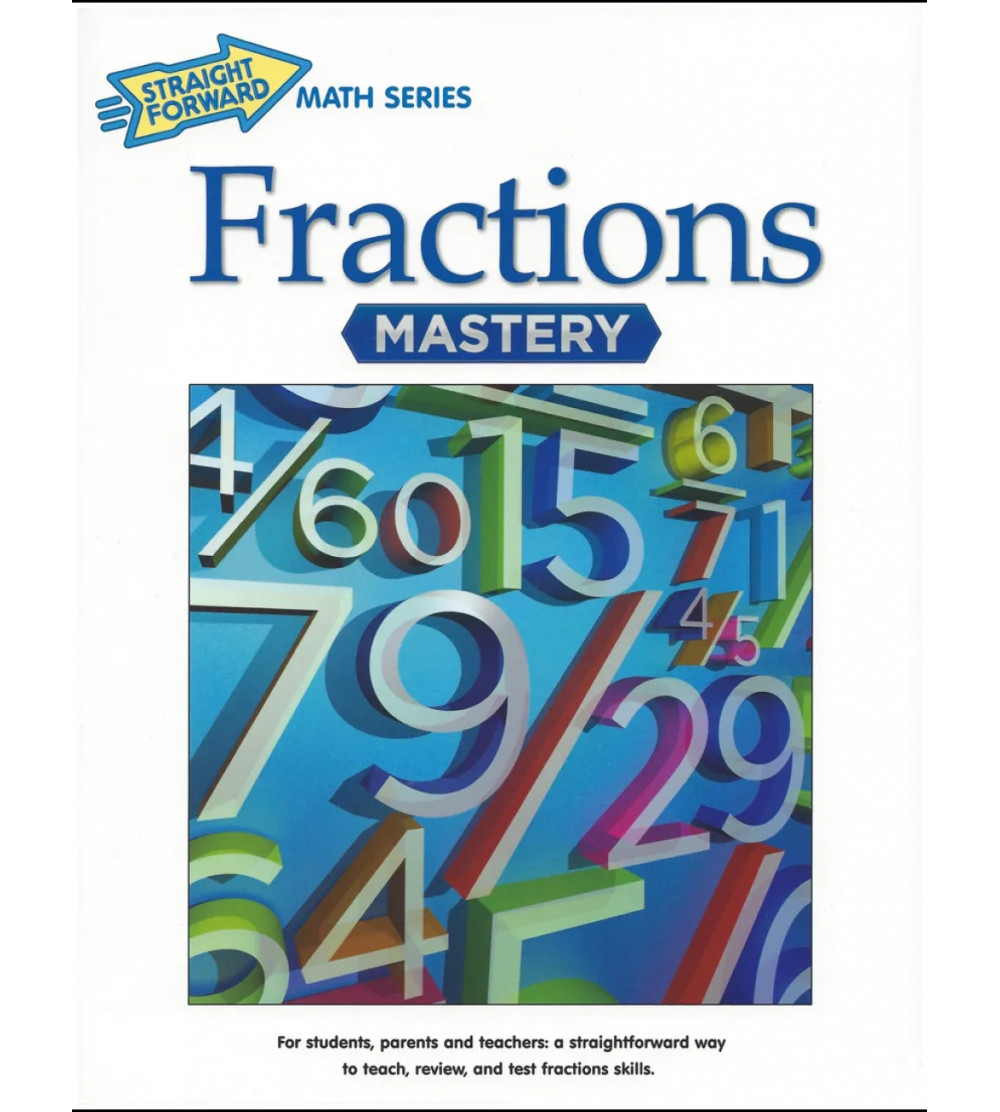
Topics include: Whole Numbers; Introducing Fractions; Addition; Subtraction; Multiplication; Division. Practice, review, and testing included. An answer key is included in this 64-page book.
Each section of this book addresses a concept important to fractions mastery. Explanations are made, clear examples are given, and exercises provide for practice and mastery. Periodic testing can be used as a simple assessment tool to measure how well a learner has understood a presented concept. All of this is done within the standards for Numbers and Operations described by the National Council of Teachers of Mathematics, with special attention to understanding numbers, understanding the meanings of operations and computing fluently.
This book is arranged in six chapters.
CHAPTERS 1 & 2:
Provide prerequisite background skills that involve fractions. These two chapters taken together provide the ability to generate equivalent fractions and to reduce fractions to simplest forms.
CHAPTERS 3-6:
Focus on operations. Chapters are marked by brief concepts and explanations, followed by examples, and finally by exercises. Each chapter has a review, to be used as a simple measure of skill attainment. A final assessment test for all skills follows the last chapter.
Table of Contents
AN APPROACH TO FRACTIONS
CHAPTER 1: Whole Numbers
CHAPTER 2: Introducing Fractions
CHAPTER 3: Addition
CHAPTER 4: Subtraction
CHAPTER 5: Multiplication
CHAPTER 6: Division
FINAL ASSESSMENT TEST
ANSWER KEY
Topics include: Whole Numbers; Introducing Fractions; Addition; Subtraction; Multiplication; Division. Practice, review, and testing included. An answer key is included in this 64-page book.
Each section of this book addresses a concept important to fractions mastery. Explanations are made, clear examples are given, and exercises provide for practice and mastery. Periodic testing can be used as a simple assessment tool to measure how well a learner has understood a presented concept. All of this is done within the standards for Numbers and Operations described by the National Council of Teachers of Mathematics, with special attention to understanding numbers, understanding the meanings of operations and computing fluently.
This book is arranged in six chapters.
CHAPTERS 1 & 2:
Provide prerequisite background skills that involve fractions. These two chapters taken together provide the ability to generate equivalent fractions and to reduce fractions to simplest forms.
CHAPTERS 3-6:
Focus on operations. Chapters are marked by brief concepts and explanations, followed by examples, and finally by exercises. Each chapter has a review, to be used as a simple measure of skill attainment. A final assessment test for all skills follows the last chapter.
Table of Contents
AN APPROACH TO FRACTIONS
CHAPTER 1: Whole Numbers
CHAPTER 2: Introducing Fractions
CHAPTER 3: Addition
CHAPTER 4: Subtraction
CHAPTER 5: Multiplication
CHAPTER 6: Division
FINAL ASSESSMENT TEST
ANSWER KEY





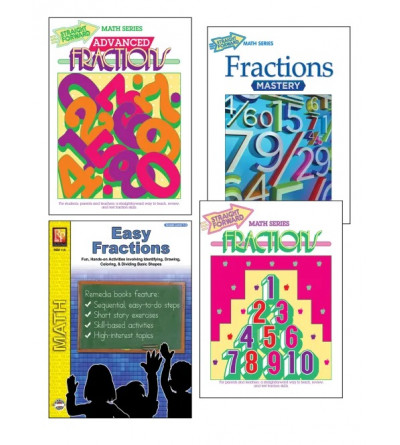



Topics include: Whole Numbers; Introducing Fractions; Addition; Subtraction; Multiplication; Division. Practice, review, and testing included. An answer key is included in this 64-page book.
Each section of this book addresses a concept important to fractions mastery. Explanations are made, clear examples are given, and exercises provide for practice and mastery. Periodic testing can be used as a simple assessment tool to measure how well a learner has understood a presented concept. All of this is done within the standards for Numbers and Operations described by the National Council of Teachers of Mathematics, with special attention to understanding numbers, understanding the meanings of operations and computing fluently.